Tuesday, September 11, 2012

The Road to Durrow


Note:  As most of you know, after staying on the Finca los Tres Alcornoques in San Vicente de Alcántara for five weeks, we headed to Barcelona, my old stomping ground from six years ago.  With respect to the blog, as we had fallen more than a month behind, any available blogging time in Barcelona was spent catching up on our San Vicente posts.  And frankly, we were too busy living the good life of city, food and friends to spend too much time writing!  Fortunately, our experiences in Barcelona do not need to be shared chronologically and we have therefore made the executive decision to stay current with the blog and skip straight ahead to our new HelpX home.  Don’t worry, you will still hear all about Barcelona.  We promise to intermittently regale you with our stories of delicious food and more delicious food, cause that’s pretty much all we did!

“The Road to Durrow”
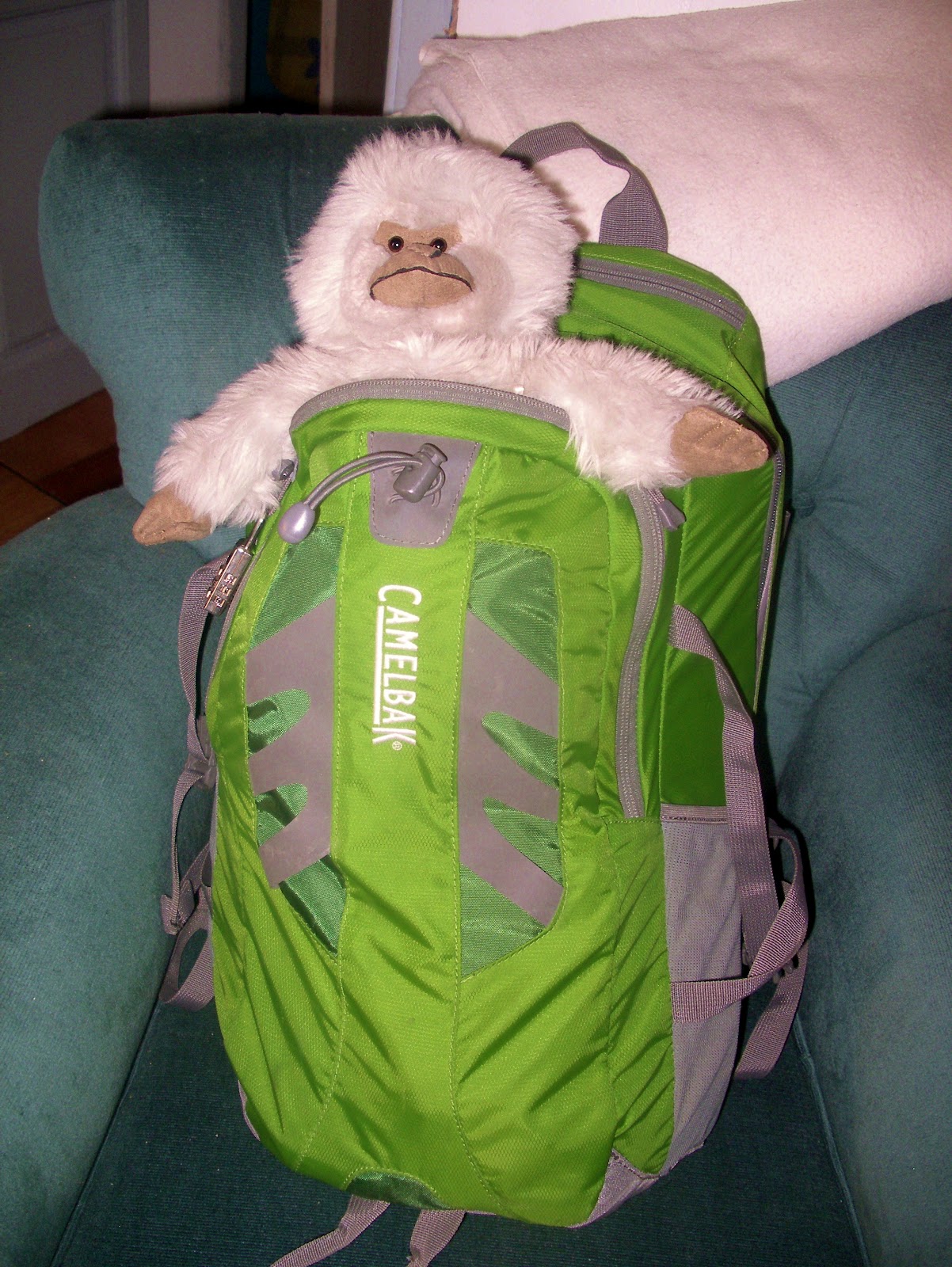
Monkey's All Packed Up!
After six weeks of visiting old friends, roaming the city and gorging ourselves on Spanish tapas, we packed our bags and left the beautiful but eternally sweaty summer heat of Barcelona for our next HelpX destination: The Gallic Kitchen in Durrow, Ireland. 

Gallic Kitchen Wares
Due to Jonathan’s diligent and persistent efforts on the HelpX website, we were able to secure two spots in the home of Irish couple, Patrick and Sarah, owners of the Gallic Kitchen.  That’s Gallic as in the French Gauls, not Gaelic as in Irish folk, a distinction which is clear after surveying Sarah’s menu of French style savory pastry pies and sweet fruit tarts.  While this HelpX host family does own horses and a fair bit of green Irish land, they are not technically a farm; however, with a fully functioning profession kitchen complete with café and several farmers’ market booths, from their HelpX profile they appeared to be an excellent segue to our next farm stay who could not accommodate us until September 1st.

Johann & Baby Bird
After an emotional goodbye to my dear old friend Johann, at 7:30 p.m. we began our journey to the airport to catch our 10:30 p.m. flight to Dublin.  After a taxi and a train ride, we found ourselves at the check-in point for AerLingus at the Barcelona airport, holding our breaths that the attendant would not actually hold us to the 20 kilo weigh limit as it was likely that our bags were a mite overweight.  Now we had weighed them with our flat mate’s scale, but unless you have a nifty luggage scale like my dad, you will never really be spot on with test weighting the bags.  In addition, our experience so far with the strictness of Spanish airlines taught us that the limit was not actually enforced (even though we were 10 kilo’s over the limit on our flight from Extremadura to Barcelona!) so we weren’t too worried. 

Turns out that we were 4 kilo’s over the limit and AerLingus being an Irish, not Spanish airline, but who’s counting, we ended up having to pay €15 per kilo, yup, a total of €60 to get our bags on the plane; not an egregious amount but coming off of a minor spending spree in Barcelona, that €60 hurt a lil bit.  I told Jonathan that I didn’t need to bring eight dresses and twelve tee-shirts, but he insisted!  Anyway, we figured we’d help that bitter pill go down with a €3.50 glass of beer and a €6 mini bottle of cava at the gate (compare with €1.50 and €2 respectively if purchased at a bar back in the city).  Brilliant.

After a three hour flight and a time zone difference of one hour, we arrived at the Dublin airport at 12:30 a.m.  As we disembarked the plane, we stifled a few yawns refusing to be tired as our bus did not leave the Dublin airport until 5:30 a.m., and went in search of a place to park ourselves and our luggage.  As luck would have it, we came across a 24 hour food court complete with fabulous vinyl neon green couches, a TV that played an Irish news program on repeat, and lights so bright that guaranteed that neither of us would sleep a wink !  We staked our claim on one of said couches and settled in for the night.

As one well knows, sitting on a plane does not stimulate hunger.  Lying motionless on a vinyl green couch does not stimulate hunger.  You know what stimulated hunger in these two situations?  Boredom brought on by sleeplessness and, well, nothing better to do!  None of the hot food counters were actually open yet and the refrigerator only housed salads and, while they were actually quite impressive and tasty looking, they were also €12 and like I said, we weren’t actually hungry anyway, just bored.  After already having finished the piece of baguette and hardboiled eggs we had brought with us, I started drifting toward the French mustard packets.  In attempts to save me from myself, Jonathan went off to see what he could see at the airport mini mart while I held down the fort watching freshly downloaded America’s Next Top Model reruns on the laptop.

Oh joy!  Jonathan returned with a bag of cheddar popcorn and a clementine for me, a bag of salt and vinegar chips and a Twix for himself, and two coconut water juice boxes, complete with sippy straw!  My sweetie always comes through! 

A couple of hours later, about 4:30 a.m., we decided we had better have breakfast since we had a two hour bus ride ahead of us and we only had semi specific arrangements for how to get to the house after that (i.e. we had no idea when our next meal would be).  Still most definitely not hungry but grateful for the change of pace, we ordered a traditional Irish breakfast to share: two rashers (back bacon), two sausages, black and white pudding (sausage patty with and without blood), two pieces of white toast, scrambled eggs, and a grilled tomato.  Just a snack to keep us going till our next meal.

At 5:10 a.m., we tromped through the rain to our bus stop just in time to see it take off with a little wave from the driver.  Uh, problem?  As it was only 5:20, ten minutes before the bus was supposed to leave, I optimistically reassured myself and Jonathan that the wave meant that the driver was just getting fuel or something and coming back for us.  My current state of mind (tiredness, bordering on grumpiness which inevitably leads to weepiness) forced me to believe that he was coming back, and frankly did not allow for any other acceptable option. 

Luckily for everyone around me, namely Jonathan, the bus reappeared at a few minutes after 5:30 and we were once again on our way.  Thus began our first foray into the complications of dialing an Irish phone number (it’s harder than just dialing the number, I promise).  With less than €5 of credit left on our prepaid Spanish phone, we tried dialing Patrick and Sarah to let them know we had made it on the bus and we would be in Portlaoise (pronounced port leash) ready for pick up at 7:30.  Our efforts rewarded us with some blathering in Spanish about the number we dialed something something something.  After various combinations of including the country code, the area code, etc., we had tried every option on the Spanish mobile phone and therefore resigned ourselves to holding off until we arrived in Portlaoise so we could find a local payphone.

As the sun continued to rise revealing a crisp Irish morning, we pulled up to the bus stop in Portlaoise.  Exhausted and ready to lay our heads on our new pillows, we went in search of a payphone.  While the chill in the air was a welcomed contrast to the sweltering, sweatiness of life in Barcelona’s August heat, not only was I tired and a little grumpy, but now I was cold.  Luckily we found a mall whose doors were open even though none of the shops were.  With only a few euros in change and virtually no credit on our mobile phone, we again attempted to call Patrick and Sarah to please come pick us up!  This time there was no Spanish monotone lady telling us we dialed wrong, not even an Irish voice telling us how to properly dial an Irish phone number, only a few clicks and beeps and sucks for you cause the pay phone ate your money…again!  And again!  Needless to say, the more euros down the drain, the more frustrated and cranky we became.

Finally, as much as I scoff at the iPhone addictions of my husband and friends, I have to admit that it was Jonathan’s iPhone and the mall’s free WiFi that ultimately saved us: “How do you dial an Irish phone number?”  Oh, you are supposed to remove the country code and replace it with a 0?  Really?  And we were supposed to know that how?  We later found out that we were not the first HelpXers to be challenged by the dialing process, hence the websites dedicated to answering the How to…question.  Thanks for the heads up, folks!

With our last euro we were finally able to leave a message on Patrick’s mobile and hunkered down on a bench to wait for a return call.  As the computer battery was almost dead, I plugged it in to an empty socket near the bench until I was confronted by a helmet wearing, Segway riding mall security guard who stated that I was welcome to use the free WiFi but not the electricity.  Ok, then.  After about 20 minutes, Patrick appeared in his blue Gallic Kitchen van and we were finally on the last leg of our trip to our final destination: our new home in Durrow!

After about a 20 minute drive through green, green and more beautiful green, we drove up the driveway, past the neighbors cows, past Sarah’s horses and the kids’ ponies, and pulled up to a large brick house.  We were immediately greeted by a bounding golden retriever who couldn’t have been happier to have yet another two people who were willing to pet him.  So far so good!  We helped Patrick unload a few supplies from his trip to Portloise into the Gallic Kitchen professional kitchen which they had conveniently built a stone’s throw from the house.  In the kitchen we met Sarah who quickly introduced us to Claire (France), Kimberly (Taiwan) and Ruth (Ireland), before immediately sending us off to bed.  11:30 a.m. marked the conclusion of our 16 hour red eye and sleepless trip, and we finally crawled into our new bed for a much needed nap.


We awakened from our nap around 5:00 p.m. at which time Patrick immediately snatched us up and took us to Bob’s Bar in Durrow for some pre-dinner chit chat and a Guinness.  Despite our slightly rough road to get here, I gotta say, between the greenery, the crisp and refreshing air, the nice people and of course Guinness, I love Ireland so far!

Tuesday, August 14, 2012

Borris the Burro: My Finca BFF


"Can I have your peach?"
Upon arrival at the Finca Los Tres Alcornoques, my favorite animal immediately became the seven year old, fuzzy eared, sweet faced round bellied donkey, Borris.  Even his name!  What a perfect donkey name!  And his signature donkey look with his head down, ears pointing up and eyes gazing at you from under his lashes is enough to make anyone fork over the other half of whatever sweet piece of fruit they are eating!  I adored him so much that I figured he warranted his very own blog post!


"Food? Is that for me? Can I have it anyway?"
 After a few days of working on the finca; however, I quickly noticed that Borris didn’t really have a job or specific purpose on the farm.  This is very unusual in a farming area like San Vicente that typically frowns upon keeping (i.e. continuing to feed and waste resources on) animals that have aged beyond productivity, hence such dishes as coq au vin (old cock) and mutton stew (old sheep).  Why, you ask, does this finca have a donkey whose sole purpose is seemingly to eat everything in sight and get in as much donkey trouble as he can?  Well, I’ll tell you!

Donkey Rides on Brighton Beach, 1976 
(photo courtesy of Yvonne Thompson)
The owner of the finca and our hostess, Brin, is originally from Brighton, U.K. and according to her, it the dream of every British child to own a donkey.  This concept seemed strange as truthfully the thought of owning a donkey had never even occurred to me (until the birth of Shrek and his Donkey, the typical American childhood has been relatively limited in donkey exposure, save Winnie the Poo’s buddy Eeyore).  The thought of owning a donkey may have seemed bizarre because a trip to the beach for most American children means sun, sand, waves and sand toys.  For U.K. children, on the other hand, a trip to the beach meant the traditional seaside donkey ride!  Ok, now I get it!  If that was your childhood beach experience, what child wouldn’t want a pet donkey? 

Side bar:  Throughout the 1970’s the popularity of the U.K.’s beach donkeys increased, as did their societal awareness of protecting animals’ rights.  In 1973, Dr Elisabeth Svendsen founded the Donkey Sanctuary in Devon, which now includes eight farms and houses thousands of rescued donkeys.  My previous statement regarding Borris’ curious nature and aptitude for finding trouble seems to be typical donkey characteristics as confirmed by Claire, one of the grooms on Brookfield Farm: "Joseph has got the biggest personality of all the donkeys here at Brookfield. If there is a yard broom he can steal - he will. If there is a pot of paint he can stick his nose in - he will. If there are builders or workmen here that he can follow around and annoy - he will."  Extremely entertaining!

The Donkey Sanctuary has also helped sanction codes that protect the beach donkeys by prohibiting excessively overweight children from riding them as well as requiring that the donkeys are given at least one hour long break per day.  You can find information on how to foster or adopt a donkey from this fascinating charity at http://www.thedonkeysanctuary.org.uk/ (after browsing this site, I searched HelpX to see whether the sanctuary participated in the farm stay exchange and needed a donkey lover and her husband, but, to no avail).

Anyway, back to my darling Borris.  So, like most British children, Brin had always had the fantastical dream of owning a donkey, but now that she and her husband had sold their house in Brighton and bought a finca in San Vicente de Alcántara, Spain, the childhood wish had the potential for reality.  However, being the practical person that every successful farm owner must be, Brin’s financial priorities were focused strictly on essentials (e.g. how to utilize the four wells and set up a finca-wide water system, etc.).

That was until seven years ago, three years into owning the finca, when Brin was approached by a neighbor who said that he had a friend who had a baby donkey and was she interested in owning a donkey?  Concentrating on whatever frustrating project was currently at hand, she briskly brushed him off, “No, I don’t want a donkey!”  The next day, “Are you sure you don’t want a donkey?  He’s a good donkey!”  The next day, “You’re sure, really?”  “No, I can’t afford a donkey.”  “Just make an offer and I will ask my friend.”  In attempts to put him off for good, Brin devised a genius plan: tell the neighbor that all she could afford to pay was €100 when, as anyone knows, the going rate for a donkey was more like €300.  Quite “fluffed up and proud” of herself, she went inside the house thinking, ha, that’s the end of that!

Much to her surprise, two weeks later, the neighbor came back to tell Brin that his friend had consented and when did she want to pick up her new donkey!  Oops.  Apparently, an unspoken San Vicente pueblo rule is that if you make an offer on something and the offer is accepted, you’ve as good as bought it (i.e. it’s really bad form to change your mind).  Not wanting to create a rift between herself, a foreigner, and her neighbor, a long time Extremaduran finca owner, she resigned herself to the three foot high, three month old baby donkey.  Done and done.

I tell you, one look at Borris' super dooperly cute face with the long ears, of course the first thing you want to do is pet his soft donkey nose.  I think that donkeys are typically pretty shy and Borris was no exception.  Every time I would walk toward him he would back away giving me the cold shoulder.  Here, Borris, can I lure you with some greens?  Nope.  Brin told me not to worry, that he would get used to me being around the finca and even though he may be the "most moody donkey on the planet", he would come around.

Every day I walked from the main house out to the huerta to perform my daily gardening and greens gathering tasks.  After a few days, I suddenly heard this clomp, clomp, clomp sound behind me.  I turned around to find out that I was being followed by a donkey, whose curiosity had finally gotten the better of him and outweighed his shyness.  Well, almost.  As soon as I acknowledged his presence, Borris stopped and averted his eyes, dum dum dee dum…minding my own business.  When I put out my hand to pet him, he took a step back.  Giving him his space and time to trust me, I turned back around and again headed toward the huerta.  Lo and behold, after a few steps, Borris resumed his stalking game and followed me to the huerta!  This went on for about a week until he finally let me pet his soft nose.  That was it…best buds for life!  Don’t get me wrong, as close as we became, he still had his moody days when he didn’t feel like getting his nose pet; that’s right, Borris, just take your blood orange snack and take off.  Fine.  You can’t come to my birthday party.

CHOMP!
Speaking of snacks, for about half the time we were at the Finca Los Tres Alcornoques, Borris and the sheep were penned right next to the huerta, with only a flimsy fence between the ravenous beasts and the vegetables desperately attempting to survive in their overgrown patch.  I already mentioned the innocent donkey face look that would make you give him anything he wants; I’m surprised any of the other animals received their promised sack of greens what with Borris hanging his head over the huerta fence begging for scoobie snacks!

The finca was designed to have several areas in which to rotate the sheep and Borris so that they will always have green grass and plants to nibble on.  A few weeks into our stay, the remaining green grass in their current paddock had been completely gobbled down, which meant that it was time to switch to a different area.  Unfortunately, the next area in the rotation needed some fence repairs because there were a few areas in which the sheep could escape.  With summer rapidly approaching and so as not to let the last bit of grass growing on the finca go to waste, Brin penned Borris in the questionable fence section and the sheep in the next section. 

The following morning we heard a desperate, pitiful donkey bray from Borris’ new pen.  As I had not yet heard one peep out of Borris since we had been living on the finca, I was slightly concerned.  Brin warned me that I should check on him because there is always a possibility that this bray is the cry, “Help!  I tried to escape and now I’m stuck!”  She said that while theoretically he cannot escape, the little fence would not stop the mischievous donkey from nibbling on and potentially creating a hole in the fence.  Apparently, one year, while penned adjacent to the pig domain, Borris managed to free the pigs!  Too funny!  As it turned out, the bray was simply, “Come play with me!  I’m bored without my little sheep friends (even though I try to kick them in the head when they come near my food)!”

One of the highlights of the San Vicente farm stay was the day I finally got to ride Borris!  He had been trained for riders and in fact, Brin had hoped that her daughter would take to riding him which would also serve as a justification for his presence on the finca.  Alas, the little seven year old had no interest unless of course someone else wanted to ride him.  Go figure. 

Anyway, after fitting him with what was actually a pony saddle, thus barely fitting around his big donkey belly, Borris and I took a test lap around the front yard just to make sure he was happy with me on his back and to make sure the saddle felt secure.  Soon we were off down the lane, clomp, clomp, clomp…uh, Borris, you’re going a little fast…uh, did I mention that it had been a while since I had ridden (i.e. at least three years)…oh, boy, just hold on, wait, this in an English saddle (i.e. no horn)!  Don’t worry, I got the hang of it and we ended up having a blast!  Borris was happy to be getting some exercise and I was happy to see more of the countryside.  We saw some big ol' pigs, horses, cows, fruit trees and even more cork trees.  We got barked at by a huge vicious dog.  We were trotting happily along...wait, a fork in the road…do I forge ahead or just turn around now?  As most of you know, my sense of direction is not always the tippy toppest, hence the slight trepidation at the fork in the road.  Luckily, the two finca dogs, Marta and Filly had decided to come along on our ride and I was confident that if I lost my way, they would be able to lead us home.  Unfortunately I do not have any pictures of this lovely countryside jaunt because Jonathan wanted to take a picture of me riding away, but the only problem with that was that I rode away without the camera!  Oops!

Well, we managed to find our way back to the finca without incident and I found that I had made a friend for life!  Clearly Borris loved the ride because after I removed his saddle and got us some water, we parked in the shade to cool off where he repeatedly nuzzled and cuddled me with his big white nose.  You see why I call him my finca BFF?  Borris, I miss you already!

Borris & Baby Bird

Friday, August 10, 2012

Where is the PigWizard on this blog?!

Notice: there are some really good lines in here, but for the most part, it's pretty crammed together in ways that may not immediately make sense.  Apologies....but this one is kinda for me.  If I took the time to explain how everything in here is related in my head, I would never finish it.  I promise to be a little more succinct in future posts.

If you've been following this blog at all, you will have noticed a distinct absence of anything from yours truly, the PigWizard.  Part of this, is because we only brought one computer with us, and most of my time on it has been researching the next phase of our journey, contacting farms and couch surfing hosts, finding the best flights, trains, and buses to get us around to unfamiliar places. Before we even started the trip, Nicole and I had a discussion or twenty, about the nature of the blog, what it's purpose was, and how we we´re going to share it. For the most part, I just wanted to write when I felt like writing, to be artsy about it, and she felt it was more accessible to readers as a chronological journal.  I've never been a good journal keeper (I have written and rewritten this post at least eight twelve times already) and so as yet she has been the only source of posts.  To paraphrase Thoreau, if I write the life I'm living, I wouldn't have time to live it.

But the main reason I haven't written is that I didn't know what to write about, and how to organize it.

For me, the food oriented aspect of this trip is about ideas and inspiration.  As a high school drop out, and a largely self taught cook and butcher, I've never had anything but my own ideas about what I should learn, and there has never been a focus or a specialty (despite what you may think of me if you only have known me as the PigWizard), I have just always wanted to keep learning, and not just about food.  While I will never stop learning, at some point you have to put what you've learned into action, stop fucking around, and make a living.  Having said that, it's kind of a sickening idea to me, owing a business.

It's a great idea in a lot of ways, but looking at the reality of scares the shit out of me.  Borrowing a few hundred thousand dollars, being responsible for hiring and maintaining employees, dealing with the myriad of regulatory institutions, writing schedules (ugh), surviving the winter months in Monterey as a food business, fixing machinery; where is the time for making cool new stuff and still learning?  Why can't I just keep doing what I've been doing for the last 19 years, hopping around wherever my curiosity takes me, making just enough to live on, and continue to follow my passion?

Ego, that's why.

I think I'm pretty awesome (no sense beating around the bush since I'm being brutally honest here), and  I think it's time to share as much of that awesomeness as possible.  This makes me a little crazy, 'cause I want as many outlets as possible to get that awesomeness out.  Being mostly self taught, with no scholastic culinary training, my resume looks like I put a list of jobs and hobbies painted on the side of a barn, and threw darts at it while blindfolded and drunk; and I'm not just talking food jobs (metal sculptor, warehouse worker, wrought iron, cabinet and furniture maker).  It seems random, but it's not. The idea of career is usually relatively linear in our society. I think that sucks.  I want my story to have some quantifiable success in order to inspire others that want to kick the American educational system in the teeth and go there own way, rather than through the excessively bureaucratic, neurotic, comatose public school system inspired by the Prussian model that incidentally lead to Hitler and the rise of Nazism.   That is to me the freedom that we fight for, the freedom to follow our curiosity to the limits of our imagination.

Let's be even more honest. While I think that cooking is largely a craft and almost never art, I, personally, am still an artist in temperament and desire.  I want to cook food that I like and want to eat, inspired by my view of the world and the food I have tasted and loved and share it to make a decent living. 

What's stopping me?!?! And how does shutting down PigWizard and traveling off to Europe for a year square with that??

Well, me of course.  And I haven´t figured out on how to put it all together.

A restaurant seems like the natural choice, but I hate working every night and missing the sunset.  I talk a lot about a butchershop also, but that doesn't allow me to put food on a plate for you very often. It's not like I watch every single sunset or want to, but I hate the idea of not having the choice.  I'm loathe to commit to one thing because I like doing so many different things, which is something I've dealt with my whole life (I might have gone to college for particle physics if I had learned about it before I left high school.) A lot of people have tried to tell me that I have ADHD or some other attention problem, but that diagnosis is a load of malarkey shat by the same Prussian model I mentioned earlier.  I am a creator, not an automaton. 

But that is not really a good enough reason, it's just an example of the kind of thinking that I'm trying to work out on this trip.  And that's why I haven't written much, because I've been in the deep dark recesses of my brain, hauling out some some moldy ideas, and trying to square them up with our future.

Artists, at their core, are philosophers by nature if not by words.  They must look at the world from multiple perspectives, and either frequently or occasionally, vomit up some sort of mish-mash from the experience of life. I say vomit, because it is involuntary most of the time, and my aversion to vomit keeps me from being only occasionally ill, as in writing this lengthy and largely unnecessary explanation of why I haven't written more.  There is also some deeply rooted bitterness that I am working through, but I´m not hauling that out in public, just acknowledging that it´s there.

So there. On to more interesting things.

One of the reasons we went to Extremadura, considered by most everyone in Barcelona to be the grundle or taint of Spain, is because of the pigs.  Loads of them, eating acorns, getting salted and becoming the most sublime of cured hams, Jamon Iberico Bellota.  In the states, a leg of average quality bellota will set you back a minimum of $900, because there is only one producer in all of Spain that is allowed by the USDA to export to the States. In Spain, even trying your hardest, at the most touristy stall of la Boqueria, buying the most grand reserve of reserves is about $480.  I'm sure that the USDA requires them to be shipped refrigerated, because the fact that the salted and cured legs have been shipped around the Mediterranean without refrigeration for thousands of years  is irrelevant.  The American observance of excessive cleanliness is part of what is making us fat and unhealthy, in my well read and educated opinion, but I'll save that for another post.

So we were surrounded by pigs, and pig farms, and of course there were hams everywhere.  Every bar, liquor store, convenience store, and grocery store had jamones from various regions and of various qualities. At Carrefour, the Spanish equivalent of a SuperWalmart, they are treated like babies waiting for adoption by Angelina Jolie, with nursemaids hovering over them, keeping them properly separated, wiping their butts, and changing their little cone diapers when they fill with too much dripping-olive-oil-like-fat.

Then there are the xarcuteria/charcuteria stores, lined floor to ceiling with swaths of swine, veritable temples of worship to products of porcine persuasion.  The most important hire for a wedding is not the bartender or the band, it is the jamon carver, and that's all he/she does.  Trims and slices leg after leg after leg of jamon.  Big weddings will have more than one jamon carver, since in most of Europe you don't go to a wedding unless you can fork out enough cash in an envelope to cover the cost of your meal plus a little extra.  Spain without jamon would be like Japan without rice.

But why is jamon so important?

During the later centuries of Islamic occupation and rule over  most of the Iberian peninsula, eating pork became synonymous with being Spanish, and partly a sort of political and religious rebellion against the Muslim law prohibiting the eating of pork.  Spanish hams were popular long before that though, praised even by the Romans, so giving up pork, and all of it's wonderful parts, was like forced conversion (something the zealots took to heart during the Inquisition), and love of jamon became a poster child of defiance and proof of where your loyalties lie.  That's a couple thousand or more years of acorny pork fat flowing through the hearts and minds of Iberians. 

Freshly Stripped Cork Oak


It is also about the relationship between animal and environment. Since slaughter was traditionally a winter time activity before the advent of refrigeration, piglets are born in the early spring,  and acorns fall of the tree in the fall, it is natural that the pigs are healthiest and most plump at the beginning of winter.  The acorns themselves are critical also. The acorns of the two predominant varieties of oak, Holm and Cork, have been eaten by people of the region during times of famine, and are high in oleic acids, similar to olive oil, which is linked to the positive effects of the Mediterranean diet.  This leads to a higher proportion of monounsaturated fats, which is less prone to rancidity by oxidation than polyunsaturated fats (which helps when you are going to hang a ham for 2-4 years), and supposedly better for you, although I personally (as well as a lot of doctors that don't get a lot of headlines) don't buy into the cholesterol theory of heart disease.

(Ok, I have to take a tangent here.  The hardening of the arteries leading to heart attacks is often attributed to by the depositing of saturated fats on the artery walls.  The question that most people don´t bother to ask, is why do these fats start collecting on the artery wall in the first place, considering that our liver produces a large percentage of said fats and that they are essential to health in the right proportion?  Cholesterol on the artery walls is a symptom, and the heart attack is a reaction to that symptom, but cholesterol is not the root cause. The reason you don't know the whole story is because there is a lot of money to be made on your ignorance.  Big Pharma, hospitals, clinics, magazines, insurance, stock holders and pension funds make a LOT of money by convincing Americans to feel good about taking medicine rather than feel bad about not changing unhealthy lifestyles.  ¨Eat all the McDonald's you want, just take these 50 different pills and have octople bypass surgery and you'll be right as rain!¨  Also, web searches are based on advertising, not fact, so much of the data that people see most often is heavily biased.  Use Google Scholar instead.)

So, despite the fact that we are here in Spain in the summer, and no pigs are slaughtered or salted on the farm in the summer, I did get a better understanding about the origin and importance of jamon.  One thing I learned for sure is that there is no way for me to bring it home, either in my suitcase or by making it myself.  The production does not translate across the ocean, because the conditions here are a large part of what makes it great. 

Cooking and eating are very emotionally driven activities, the best return a cook can ask for is joy and gratitude.  I am grateful for the small amount of praise and attention my own work has gotten, but I think I need to appreciate that and many other things more often, and enjoy what I've got with a little more regularity rather than looking for more. Maybe that will clear my head to help me figure out what the next step is. So, I'm going to tip my hat to Mary Schley, and produce a little list, which is in no particular order.  Do not in any way feel like you have to read it all.

Some of the things I am grateful for: my hands and the pleasure I get using them to create things; the chance to travel, the deliciousness and versatility of pork; the internet for keeping in touch and nerding out on research papers; my health; great coffee; my mom, brother, and grandmother; bacon; learning to type in fifth grade; the writing of Frank Herbert and Henry David Thoreau; being born in the US; the work of Isaac Newton; dinners with friends; beach parties; my friendship with Dustin and Karen; the lyrics of Tom Waits; sunsets; beer; gas stoves; big bathrooms where your butt doesn't stick out of the shower when you have to bend over to pick up the soap; toilet paper; BSF&W; mushroom foraging; spearfishing; braised cheeks; PBS cooking shows; hugs; rye whiskey; pickled sardines; Jamaican rooibos tea at Acme; lots of passionate friends that inspire me; pencils and paper; my martial arts training; my many, many mentors, including but not limitied to: Kurt Schmitz, James Campbell, Todd Fisher, Craig von Foerster, Dory Ford, JackieThurman, Ian James; good balance and flexibility; my guitars, even though I can't play them yet; foie gras; Nicolas, for giving me the nickname PigWizard; sodium nitrate and nitrite; ribeye steaks; tools made to last a lifetime; knowing how to use a chainsaw without losing and arm; hot tubs; Dansko clogs; that my brother didn't die when I put him alone, in a canoe, on the swollen-by-snowmelt Colorado River; the Bill of Rights; and cheese, glorious cheese.

The first will go last: My beautiful wife, Baby Bird (Brain) Nicole, for marrying me, and for telling me how much she loves me a thousand times a day, along her gracious and loving family, for treating me like one of their own from the very beginning.


Thursday, August 2, 2012

San Vicente de Alcantara: Pueblo Events


Two events marked the cultural high points during our stay at the Finca Los Tres Alcornoques in San Vicente, region of Extremadura, Spain: the city wide celebrations of Corpus Cristi and the victory of España’s fútbol team against Italia in the 2012 Euro Cup (the disco lights, smoke machines and synthesized flamenco was the cultural low point but that’s a whole other story). 

Corpus Cristi Procession
The day of Corpus Cristi celebrates the confirmation and first communion of the pueblo’s eligible children.  Spain being a very Catholic country, this day is a momentous event in the lives of both the children and their families.  Dressed in their bridal white and fine suits, the children emerge from the church in a grand procession of musicians and ornate alters and slowly and reverently march through the colorfully decorated streets.  Crowds of people from San Vicente and beyond gather on the sidewalks to watch this breathtakingly emotional procession.  After the children and their entourage complete their city block long circular march, they return to their homes or the homes of their friends for a feast and further celebration.  Unfortunately, as we did not have a friend or family member confirmed into the church that day, I am unable to elaborate on the feasting.  I can, however, elaborate on what constitutes “colorfully decorated streets”.

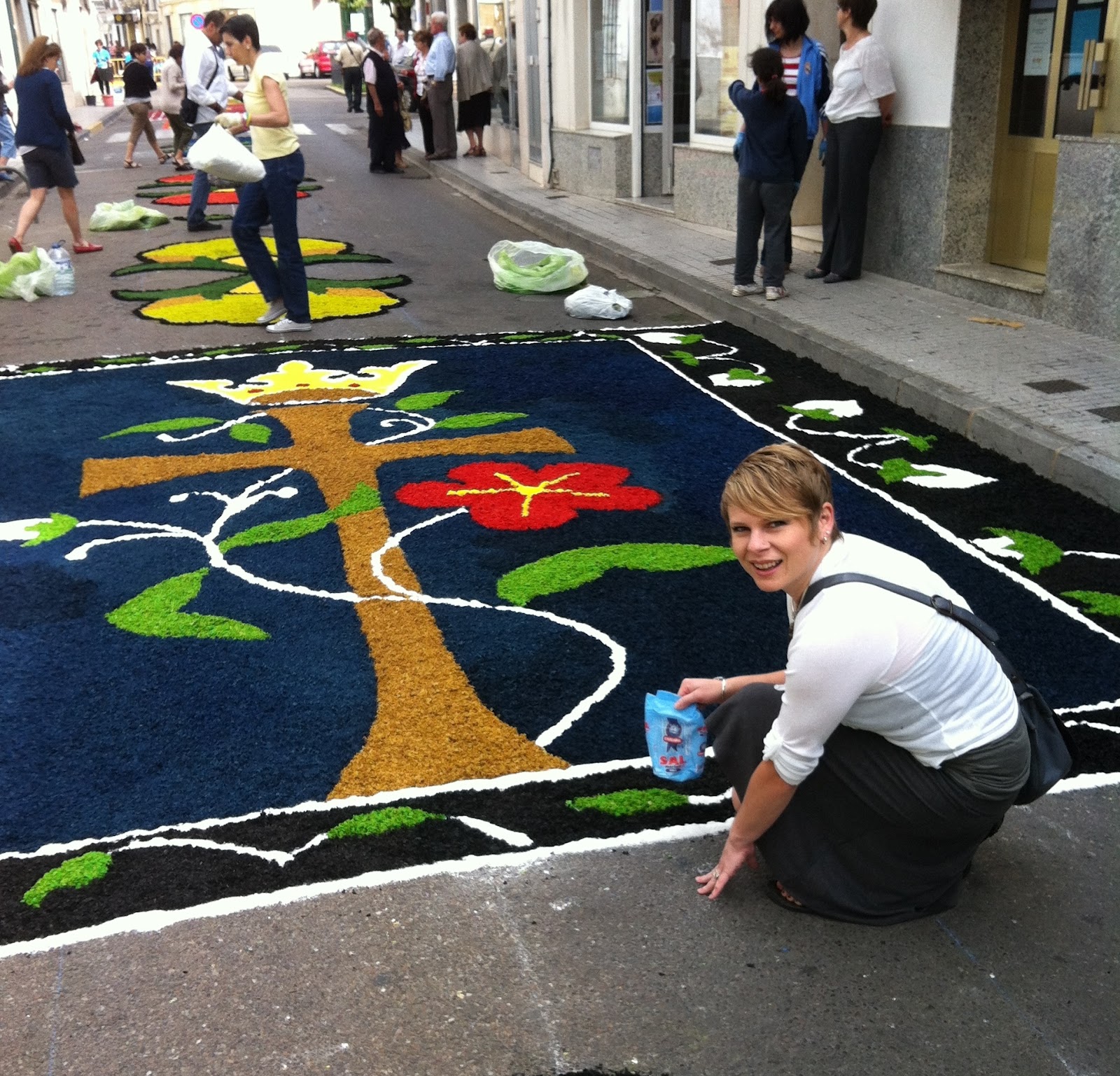
Months prior to the actual event, the planning begins.  A leader is assigned to each section of the street to be decorated.  The leader collaborates with their fellow decorators to devise a design concept.  Common themes are flowers, the crucifixion of Jesus, doves, variations of INRI, the marriage of wheat aqsn grapes as the body and blood of Christ, etc.  The leader is responsible for ensuring that their team has enough materials in order to complete the whole design.  The day before the event, the design is sketched onto the street with chalk covering the street from sidewalk to sidewalk.  The actual decoration and completion of the artwork starts as early as daybreak on the day of the event.  This is where we came in.


Brin & Elli
Apparently Brin and her daughter, Elli had been volunteering to help with this event for years, and trust me when I say, these folks need all the willing volunteers they can get in order to finish before the 1:00 p.m. procession start time.  Why, you ask?  Well, because those colorful bits lining the streets are large salt crystals, sand, sawdust and wood shavings, dyed and painstakingly placed within the lines of the chalk outline in order to create these amazingly beautiful designs!

We arrived early that Sunday morning, were given a cup of coffee and a pastry and handed a pair of latex gloves to protect our hands from the dye.  Each section was labeled with chalk as to which color went where.  The idea was to make the layer of shavings thick enough to fully cover each section but not so thick as we did not want to run out of any colors.  Oh, and  I hope everyone seasoned their celebration feasts ahead of time because in order to fill all the pure white sections, neighbors hauled out bags and bags of table salt!  It was hard work bending over and kneeling for hours; some ladies even brought pillows or strapped pads to their knees! 


After finally finishing our section of the street, we ventured out along the rest of the circular pathway to check out what the other blocks had done.  The intricate shapes and color grading that could be done with salt and wood shavings were truly amazing!  The patters seemed to go on and on, all that meticulous work for hours and hours to honor the confirmation and first communion of these Catholic children; you could feel the pride radiating through the pueblo.  What an experience!


Really, these were all made of salt, sand, wood shavings and tedious work!


Speaking of pride, I must say that the greatest display of Spanish national pride occur when Spain wins their fútbol (soccer) matches.  I experienced this years ago when I lived in Barcelona.  Every time FC Barca (Fútbol Club Barcelona) played, the bars were packed, and I mean packed like sardine tins, from wall to wall with zealous fans, jumping and shouting at every play. To the left is the bottom of the pool at out friend's beach house: the symbol of FC Barcelona.  I'm telling you, these people are obsessed!


Our last week on the Finca Los Tres Alcornoques, Spain played Italy in the final match of the Euro Cup.  Of course we had to go!  Every time Spain scored, the whole bar erupted in shouts of “¡Yo soy Español!  ¡Yo soy Español! (I am Spanish!  I am Spanish!)”  The energy was contagious, especially since Spain ended up winning 4-0!  After the match we walked through the streets, drinking beer (it’s legal to drink on the streets in Spain) and cheering along with the Spaniards.  Cars full of half-naked people painted the red and yellow of Spain, zoomed around honking.  Others cheered with their bull horns and megaphones.  Even the old abuelas hung over their balconies with their Spanish flags flying high.  High on victory, marijuana and or beer, die-hard fans even jumped in and out of the fountains whooping and splashing with joy. What a night! 

To walk the relatively quiet, very plain and unadorned streets of San Vicente during an average day, one would never expect the vibrancy and beauty that the pueblo exuded on these two momentous occasions and we were most grateful to be a part of it all!

Monday, July 30, 2012

Fiesta at the Finca of Pablo Luis


In addition to working hard and gaining knowledge on the actual finca, another goal of these farm stays is to experience as much local color and culture as we can.  This proved to be a little difficult on the Finca Los Tres Alcornoques as the distance from the finca to the pueblo required the use of a car.  There were two bikes at our disposal but seriously, the summer heat of the land locked San Vicente did not turn the bikes into a very inviting option.

Needless to say, when we were invited to a party hosted by a neighboring finca, we were excited!  The owner of the finca was an Extremaduran man in his early forties called Pablo Luis, who in his earlier years had worked as a human shield in Colombia.  His job was to accompany political dissidents thereby insuring their protection from public retribution.  It was in Colombia where he met his beautiful wife, with whom he returned to his family finca in San Vicente.  When Brin told him that she had two Americans staying with her and could we come to the party with her, he gave his consent, as long as we were not marines (don’t ask, I didn’t).

Immediately upon arrival at Pablo Luis’ finca, after the traditional two cheek kisses were distributed, we were offered an appetizer of homegrown figs which had been soaked for 11 months in a liquor equivalent to grappa and then dipped in dark chocolate.  As I bit into a fig, the flavor progressed from the sweetness of the chocolate, to the fruitiness and earthiness of the fig, to, BAM!  Alcohol!  Holy smokes!  Amazingly delicious not to mention that after two figs on an empty stomach, I had a nice little buzz going! 

According to Brin, and as we witnessed firsthand, there are very specific times throughout a Spanish fiesta that particular types of alcohol are to be enjoyed. As more appetizers appeared, including home cured jamón, olives, and of course Spanish tortilla (a very traditional frittata-like dish), we quenched our thirst with Estrella Damm, a typical Spanish lager, and tinto de verano, a refreshing mixture of red or white wine, lemonade, and agua con gas (bubbly water). 

Brin had described Pablo Luis and his friends as “hippy dippies” which translated into a dress code of loose flowy pants and dresses, an overall liberal and friendly atmosphere and the passing and signing of a petition against closing the railway station in San Vicente.  Their “hippiness” also manifested in the array of grain and vegetable based dishes like garbanzo bean curry and spelt with tomato and onion.  Clearly, my cous cous salad with mint, parsley, cucumber, red pepper, and onion was a huge hit, in fact, the first dish to go!  In addition to these dishes, what’s a Spanish potluck without deviled eggs topped with tuna, pan con tomate (bread with tomato) and potato salad?

After dinner and the Estrella and tinto de verano glasses were cleared, out came bottles of wine, a traditional rice pudding and an ice cream cake, not so traditional but yummy none the less.  Clearly this is not a culture that frowns upon mixing types of alcohol as we soon found that there was yet another phase of drinking.  After dessert, the wine was replaced with cocktails and homemade liquors, such as the 11 month old fig liquor and similarly aged plum liquor.  These were unlike anything I had ever tasted.  Strong but pure in the flavor of the fruit, not doused in sugar and artificial chemicals like many of the fruity liquors I have tasted in the States.  And it just keeps getting better as I have recently learned that my dad has planted fig and apricot trees in his yard, and I happened to have a near and dear friend, Katie Blandin, who just happens to be a cocktail mixtress.  Let the steeping begin!